Streaming on HBO (4-part series)
IMDb rating: 8.4
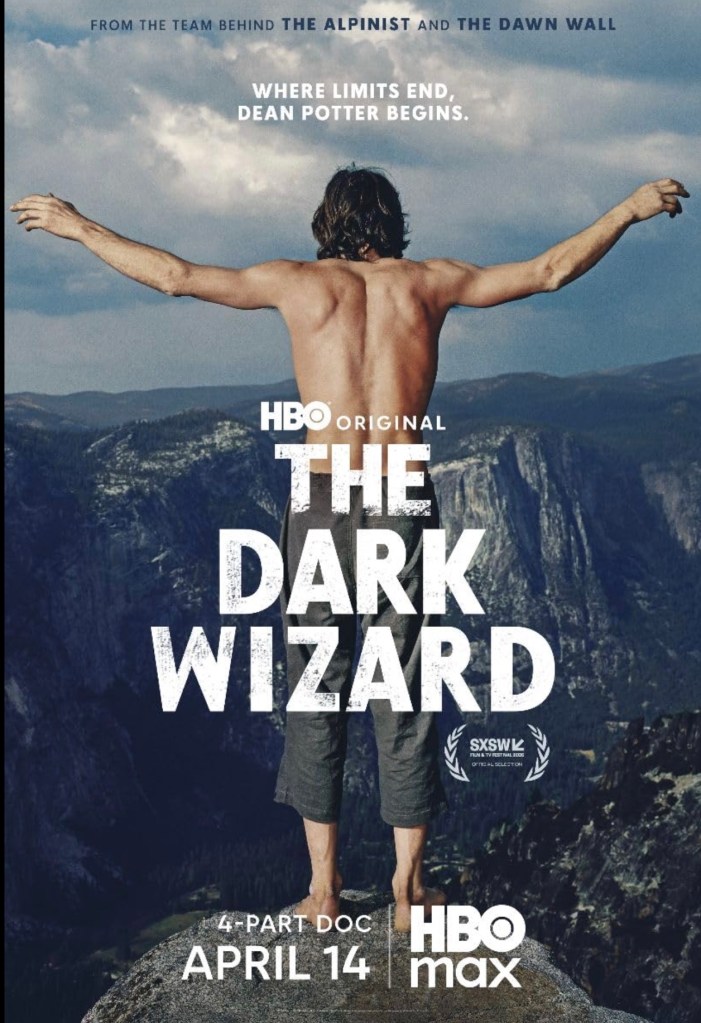
It seems like the best documentaries make you feel conflicting emotions. That was definitely the case with “The Dark Wizard.” It’s directed by Peter Mortimer and Nick Rosen, the team behind Valley Uprising and The Alpinist, and the access they had is wild because they actually filmed Dean Potter for about a decade.
If you’re not into climbing—and even if you watched Free Solo (2018)—you’ve probably never heard of him. Potter was a free solo climber, a highline walker, and a BASE jumper. Instead of tightrope walking between the Twin Towers (Man on Wire, 2008), with highline walking, the rope is strung between two cliffs hundreds of feet up. With no tether. Because that’s no fun. Wingsuit BASE jumping is jumping off a cliff wearing a wingsuit that turns the body into a virtual glider. If you want to see a cinematically stunning documentary about wingsuit jumping, you’ll get an adrenaline rush just from watching National Geographic’s Fly (2024).
The doc opens with footage of one of Potter’s climbs that almost killed him and then loops back through his life using archival footage, his personal journals, and interviews with the people closest to him, including his sister Elizabeth, who is an executive producer on the series.
What it’s really about
For me, “The Dark Wizard” isn’t so much about the sport of climbing or what he did to advance it. It’s about what it costs a person who is compelled to the point of obsession to be the best. And nothing less is acceptable. Potter was tall, lean, intense, and almost from the beginning, he was convinced that he was destined to do something extraordinary. He moves to Yosemite as a young man, basically lives there, and reinvents what’s possible on those granite walls.
You watch him pull off feats that don’t even seem real. Free soloing routes (that’s climbing without ropes) that experienced climbers wouldn’t touch with full gear. Walking a slackline over a thousand-foot drop with nothing underneath him. And he loses his balance but manages to catch himself and swing around to position his feet on the rope. Even typing this is making my hands clammy. Watching Potter hanging out in the space between alive and not-alive is jaw-dropping. Don’t watch this if you want to get to sleep any time soon.
Here’s what got me. While he’s doing all this, he’s also keeping these private journals where he sounds like a completely different person. He sounds anxious and doubts himself, wondering why he can’t just be normal. The directors had access to those journals, and you can tell that even people who knew him well were surprised by what was inside.
Bad Sport
A big chunk of the middle is about Potter’s rivalry with Alex Honnold, who is younger, friendlier, more media-savvy, and on his way to becoming the climber the general public would actually recognize. (This was before “Free Solo” won the Oscar.) They’re both circling the same prize, which is being the first person to free solo El Capitan.
Watching Potter handle that competition is rough. He isolates, gets paranoid, and picks fights with sponsors and friends. There’s a scene in China where he takes a highlining job, and as you watch it, you can tell it’s a bad idea.
I wonder if what it took for him to keep pushing the limits made him edgy and brash, or if that’s how he was going to be this way, and the climbing was the only thing keeping the lid on. I so appreciate that the doc doesn’t pretend to know.
A softer landing
The fourth episode is the one that wrecked me. Late in his life, Dean meets Jen Rapp, and for a while, it seems like the noise in his head finally gets quieter. He even falls in love with his dog, Whisper, and he’s such a good dog dad, well, kind of. He’s still doing high-adrenaline stuff, like wingsuit flying (he’s now obsessed with wingsuit flying, which is the closest a human ever gets to actual flight), but you see him laugh, you see him be a person, you see him be loved. He’s softer in a good way.
The final landing
And then you watch him drive out to Taft Point. You know what’s coming. The director’s handling of it is restrained, without high drama. It’s not needed. A man who finally was surrounded by a loving, supportive family and seemed to be okay (but was he really?), until he couldn’t resist the pull of being number one. He must have reasoned away the compelling facts that pointed to the impossibility that he could ever overtake his fellow climber and BASE jumper, 29-year-old Graham Hunt.
A few thoughts
When they’d first met, Potter acted as a mentor to the younger Hunt. But Hunt progressed quickly, especially in BASE jumping, and flew through these “exits” of formations in Moab—something Potter was hoping to be the first to achieve. It’s like the mentee outperformed the mentor, and that reignited Potter’s fierce competitiveness, something he thought he’d outgrown.
At the end, we see Potter’s Yellowstone buddies, who parted ways with him years before and were not on speaking terms. I wonder if Potter ever thought about apologizing to those early supporters and rekindling those friendships, or if his ego wouldn’t let him go there.
I think about how hard it must have been to love somebody like Potter. I mean, I bet he was magnetic and interesting, but knowing his high tolerance for risk must have been stressful. And he was obviously an obsessed person. Take how he treated Whisper—how he went through the process of having a wingsuit made for him.
This might come off as wrong, but one of the most poignant scenes was at the end when Jen approaches Whisper’s doghouse and has to coax him to come out. He’s grayer, wider, and oh so slow. But then, he totally leans against Jen’s leg and lets her love on him. What went through my head was, “Aw, why is he in a doghouse? He was sleeping with Potter in his bed in earlier footage. Isn’t he allowed in the house?” It’s so sad to see how depressed dogs get after losing their human.
It was haunting how Potter seemed to begin his life in Yosemite and end it there.
Your turn
What was your experience watching this?
What did you think of Potter? I didn’t like how describing him as an “alpha” was used to kind of excuse bad and controlling behavior at the beginning. And then the photographer guy seemed to be so quick to forgive—but that could be due to the power dynamic.
Did you see those poor Chinese commentators not know what to do when he was endlessly sobbing?
Do you think his depression played a part in his adrenaline-seeking behavior? I do.


Leave a Reply